Church communities in Germany are currently facing profound transformation: declining membership, shrinking resources, and a shifting role in society. This raises a central question for many congregations:
How can churches remain present in the social fabric of cities and neighborhoods – as places of encounter, spiritual inspiration, and active contributors to urban life?
Buildings Are More Than Infrastructure
One particularly sensitive aspect of this transformation is the future of church buildings. Decisions about preservation, repurposing, partial demolition, or closure cannot be reduced to technical assessments or simple “building traffic-light systems.”
These buildings carry meaning. They are tied to identity, personal histories, and strong emotions. That is why such decisions require processes that allow for participation, dialogue, and clarity – while still leading to sustainable outcomes.
A Recent Example from Our Work
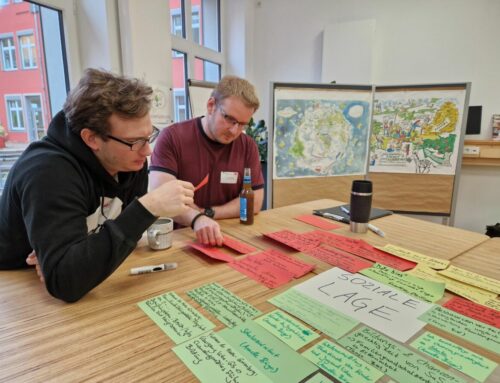
Just a few days ago, we facilitated a strategy retreat for an authorized committee of a large parish. A group of around 30 members is currently preparing to make decisions about a wide range of properties – including churches and community buildings.
The goal of the retreat was not to make immediate decisions, but to create a shared space for thinking and working toward the future.
Human-Centered Approaches for Complex Decisions
A creative and participatory process proved particularly effective, including methods such as:
-
Personas (“Who are we church for?”)
-
Future scenarios using LEGO models and visual storytelling
-
World Café sessions (dreaming, critique, feasibility)
-
Backcasting and process planning through autumn 2026
The retreat made one thing clear: strong decisions require solid data and clear frameworks. But they also need space for uncertainty, farewell, and hope. Only where facts meet lived experience can new ideas emerge — and decisions become truly viable.
Supporting Transformation Through Strategy and Participation
This is exactly where we support transformation processes. Based on our experience in research, urban development, and public-sector organizations, we know that change succeeds only when strategy, communication, and participation are designed together.
Church communities face a unique challenge — but also a significant opportunity: to shape future-oriented places that connect people, strengthen neighborhoods, and make church tangible in new ways.
For us, this work is both demanding and deeply meaningful — and clearly an investment in the future.
#Transformation #ChurchDevelopment #OrganizationalChange #Participation #FuturePlaces #ChangeManagement #UrbanDevelopment #Facilitation #StrategyProcess #city2science