What does it take for a successful initiative to continue once its project funding comes to an end?
And how can partners prepare for that transition?
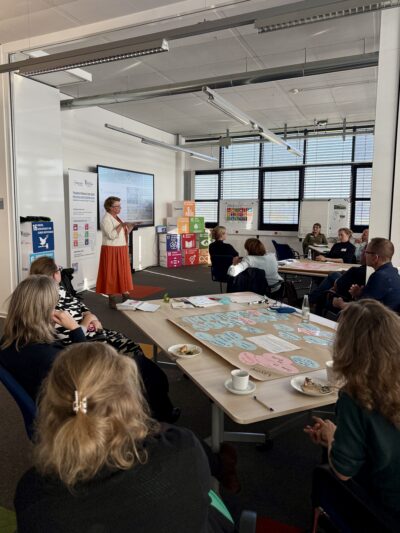
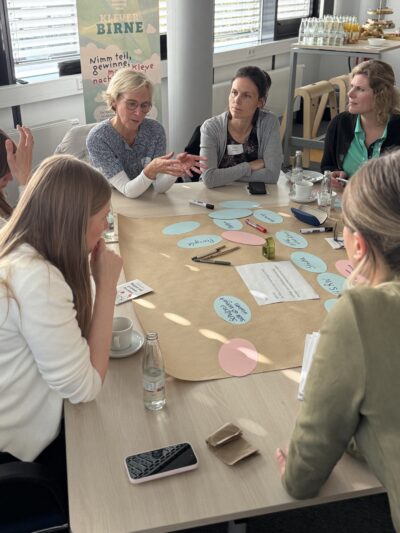
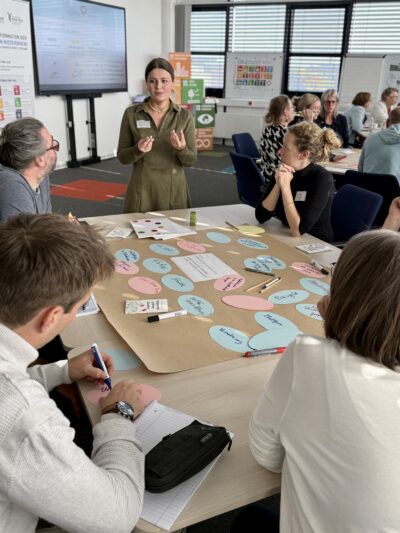
These questions brought representatives from universities, municipalities, businesses, foundations, schools and regional networks together at Rhine-Waal University of Applied Sciences (HSRW) in Kleve on 15 October 2026. city2science designed and facilitated a stakeholder workshop to explore the future of the Klever Birne, a regional sustainability competition developed by the university and the city of Kleve as part of the TransRegINT project.
Since 2023, the Klever Birne has encouraged people across the region to turn sustainability ideas into action. Its diverse initiatives range from community gardens, raised garden beds and edible forests to reusable coffee cups, neighbourhood sharing schemes and the Clever Klimadetektive, inspiring schoolchildren to explore environmental challenges.
With another year of project funding ahead, the partners are already looking beyond the current programme. How can the Klever Birne continue to support local innovation and sustainable development in the years to come?
Understanding value before designing structures
Discussions about the future of funded projects often begin with questions of money, ownership and organisational responsibilities. In Kleve, we deliberately started somewhere else:
What makes the Klever Birne valuable to the people and organisations involved – and what would motivate them to continue their engagement?
The discussions revealed benefits that extend well beyond the competition and its prize money.
For businesses, the initiative can provide visibility for innovative teams and help attract young talent to green jobs. For municipalities, it creates opportunities to connect local initiatives and strengthen regional cooperation. For schools, it offers recognition and encouragement for young people who want to make a difference – in their classrooms, families and communities.
These different expectations matter. A future organisational model will only work if it connects the interests of participants with those of sponsors, institutional partners and other supporters.
The people behind sustainable initiatives
Another important question concerned the people who make an initiative work.
Successful projects need individuals who carry the flag – representing their purpose, building alliances and connecting them to wider institutional and regional strategies. But they equally depend on those who keep the plates spinning – organising activities, maintaining relationships and making things happen on the ground.
Both groups need recognition, resources and the support of their institutional leadership.
During the workshop, participants explored different possible futures for the Klever Birne: as a highly visible regional sustainability award, as a platform supporting promising new ideas, or as a network connecting people and organisations committed to sustainable development.
Rather than choosing a structure too early, the workshop helped identify the values, interests and relationships on which a future model could be built.
From a funded project to a shared commitment
The experience in Kleve illustrates a challenge familiar to many collaborative projects: Long-term sustainability cannot be secured through funding and governance arrangements alone.
It depends on people and organisations recognising the value of an initiative, seeing their own contribution reflected in its future and being willing to take responsibility for it.
The question is therefore not simply who will take over when the funding ends, but why people would want to carry on – and what they need to do so.
city2science thanks the TransRegINT team at Rhine-Waal University, particularly Christina Martens and Lisa Stein, and all workshop participants for their openness, commitment and constructive discussions.
Further information: Klever Birne 2026